← Home

The Place Where Two Roads Met

Holly Dale Shapiro  ·  Zach Shukan

Holly
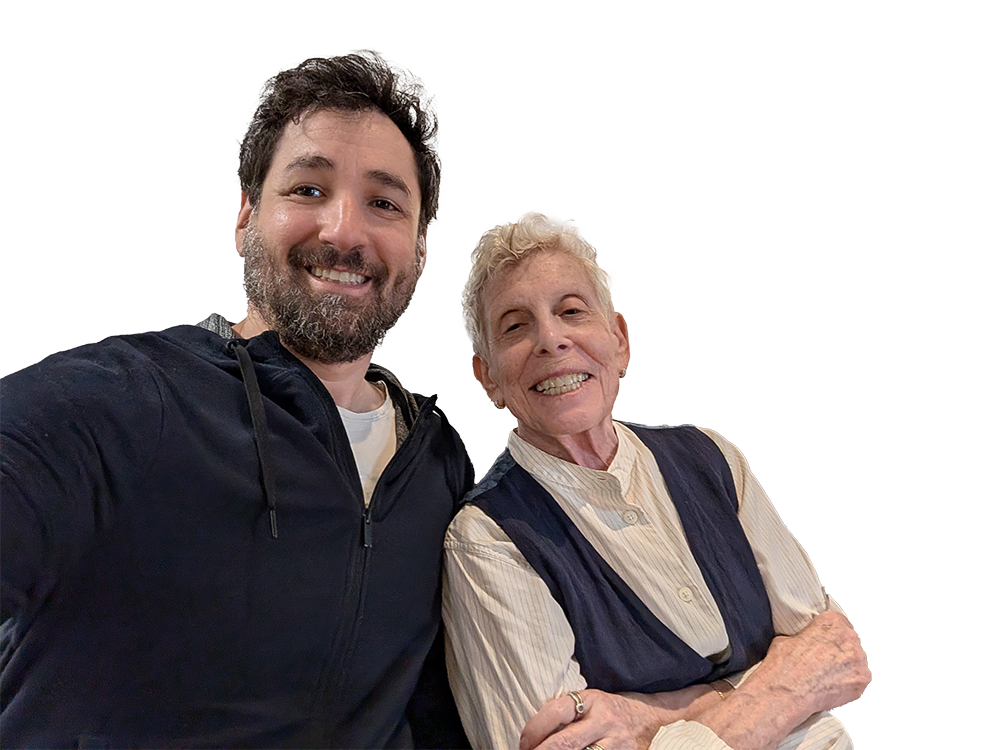
          Dale Shapiro and Zach Shukan, September 2025.

This is a collaboration between two libraries. Holly Dale Shapiro has spent a lifetime building one of them — a library of collages, paintings, drawings, sketchbook pages, and the very specific way she puts color and image together. Zach Shukan has spent his career building the other — a library of computer animation, custom software, 3D printers, and a growing catalog of descriptions of how Holly's work is made. The pieces in this document are what happens when those two libraries collide like peanut butter when it crashed into jelly.

Holly works the way a jazz player improvises. A sketchbook is always within reach. An art-catalog clipping gets a crayon drawing on top of it, then red marker for color blocking, then glue and cutout paper lips. Zach takes those pieces and tries not to break that quickness. He uses computer-vision tools to hold on to the exact shapes Holly drew, and a hand-built catalog of descriptions of all the steps Holly took to make them — the frayed edge of a marker on a certain paper, the shadow a layered collage casts on itself, the colors she uses that nobody else would put together. Those go into a chain of models running locally on his own computers, and what comes back out is something that still feels like Holly, but at a scale and in a form that her sketchbook alone could not produce.

We think of it less as generation and more as synthesis. Nothing on these pages is invented from nothing. Everything here is a reassembly of work that already existed — Holly's, and the long history of art and whim she draws from. What is new is the combination.
Isaac

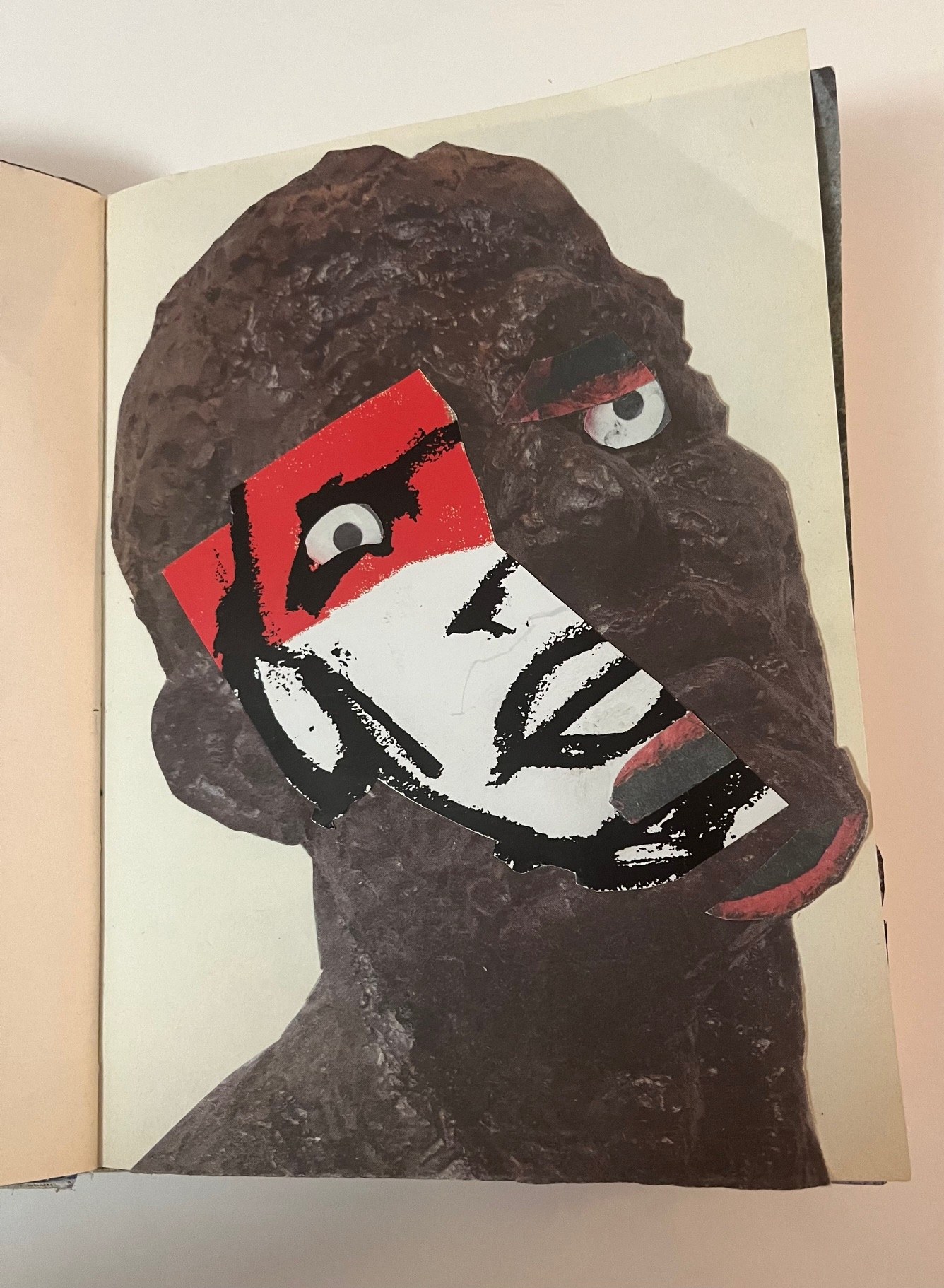
Original notebook
              collage: a sculpted head photograph with a magazine-cut
              crayon drawing overlaid as a mask on the face.

Original notebook collage

Holly

The original collage came from a sketchbook I carry around and fill to entertain myself at slow moments. This started with a picture I cut out of an art catalog. From there I added a crayon drawing that I printed out. I then added red marker to make color blocking, as well as stickers.

Zach

I don't mean "doodling" as a small word. I think of it the way musicians think of noodling — sound doodling, jazz improvisation — which is a high form of art. A sketchbook makes that possible for a painter. The barrier to a new idea is short: pick the book up, cut something out, draw on it. The Isaac piece begins there, and almost everything in this document is a downstream consequence of that one moment in a notebook.

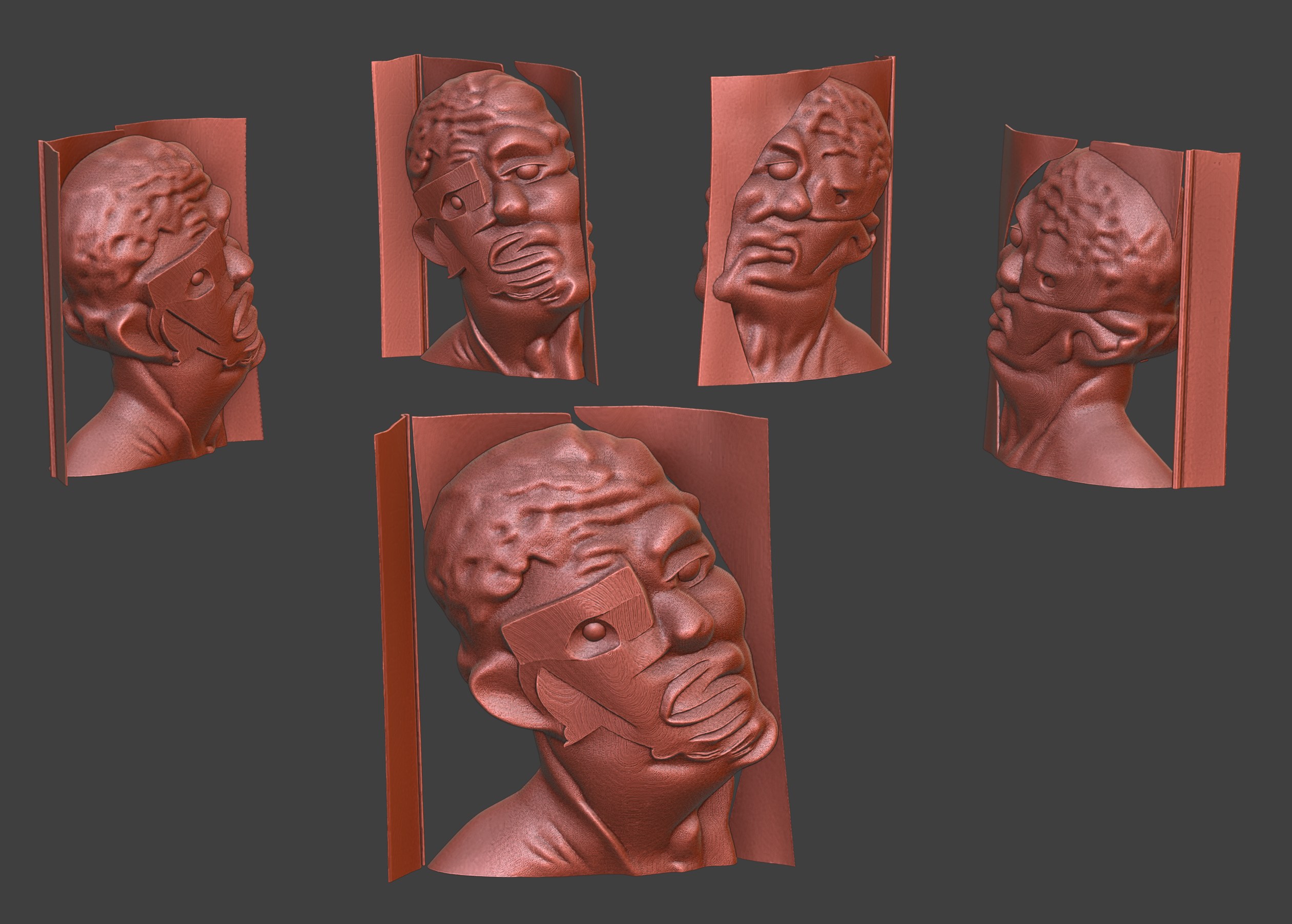
CGI sculpture from five
              angles, rendered in a clay-like red material.

CGI sculpture from the original

Holly

These 3D heads' back, front, and side views are adapted from the original image.

Zach

Getting from a flat collage to a sculpture that can stand up in a room is a few different jobs stitched together. The first job is keeping faith with what Holly already drew. I use computer-vision tools to lock on to the exact shapes she put down, and a written description — built up over months — of the materials and gestures in her other work, so the machine has the right ingredients in front of it. The second job is sculpting. I bring the result into ZBrush and Blender and rework it until it is something a physical object could actually be. The third job is breaking it apart...

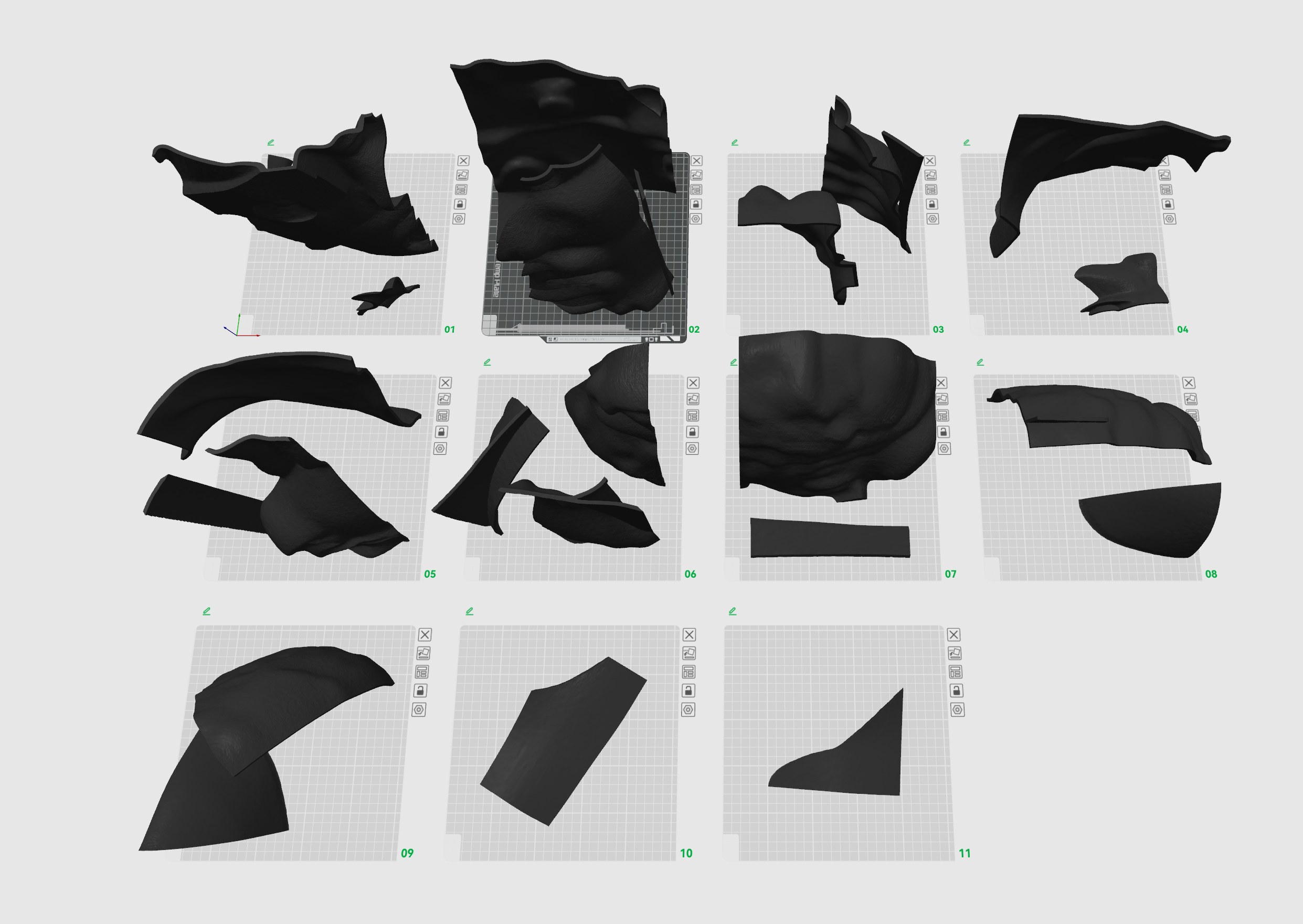
Eleven 3D-model pieces
              laid out flat across multiple print beds, prepped for 3D
              printing.

Eleven plates prepped for 3D printing

Holly

We did a small 3D print run of 11 pieces. From there we enlarged the small pieces to large ones so that we could make a large 3D sculpted head, 360 degrees round. We will have to find manufacturers to do the process.

Zach

A sculpture this size will not fit on a desktop 3D printer in one piece, so it has to be cut. I could not find an existing tool that did this well for very large sculptures, so I wrote one — a Blender add-on that slices a single model into pieces sized for my printer and adds the pegs and notches that let those pieces click back into the right alignment afterward. The eleven plates on this page are the result. Each one fits on the print bed, and each one carries part of the seam that will become the surface of the finished sculpture. To produce a full-scale, gallery-size version we will need a manufacturing partner with a larger machine, but the segmentation logic is critical for what we have access to right now.   

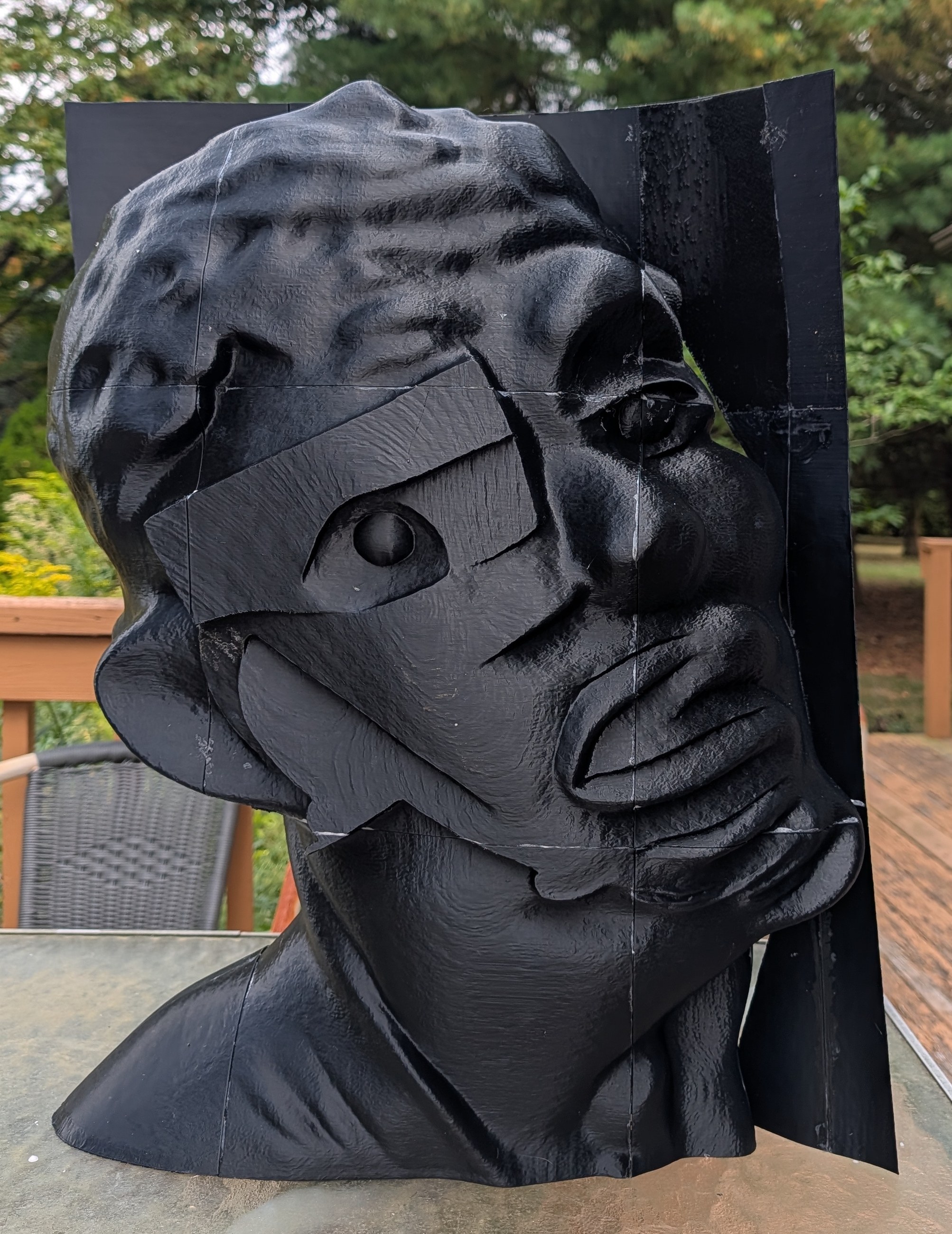
The assembled 3D printed
              head photographed outdoors, black plastic, showing visible
              seams where the printed plates meet.

3D print, assembled

Holly

This is the assembled 3D print. On this piece you see seams, and from this we can go on to testing textures, color, materials, and finishes. We will have to find manufacturers to do the final product.

Zach

This is a current state of the project, not the end of it. The pieces here were aligned by eye and joined with a solvent that briefly melts the plastic on each side of the seam and then re-hardens, so what looks like a glue line is actually a fused bond — usually stronger than the printed layers themselves. The version of the alignment software I am developing now will create physical click-in pegs to reduce the visibility of the seams. We've also been trying out various finishes for the final surface.

Only Rainbows

Only Rainbows
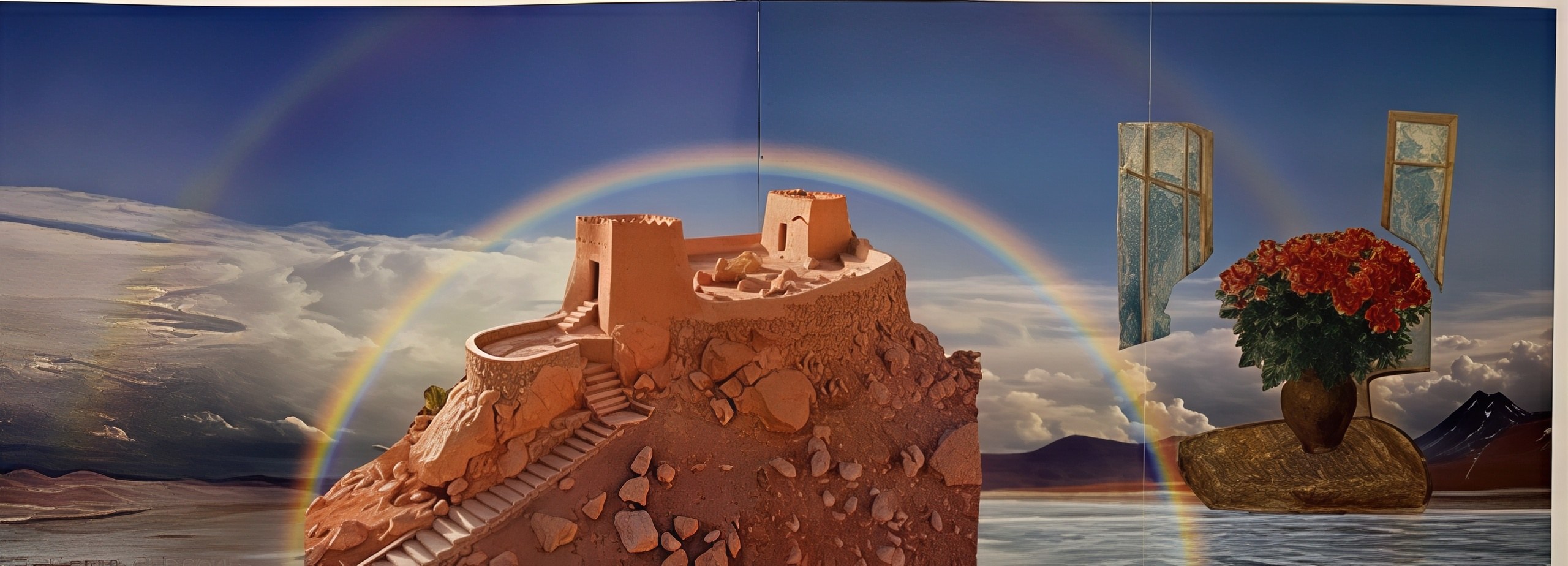
              original collage: a landscape with a clay-colored walled
              city under double rainbows, with floating window frames
              containing red flowers off to the right.

Original notebook collage

Holly

The collage of Only Rainbows was a fantasy piece. It was built from magazine cuts. The premise was a new-world dream — a world way out in the ocean that exists as fairytale peace, a place one can travel to and walk through, made up of rainbows and the sky and where oceans flow together.

Zach

Only Rainbows is the piece that opened the door for everything that came after Isaac. Isaac is a sculpture problem — one head, one form, one finish — Only Rainbows is a collage, and being confined to two dimensions has inspired us to go in every direction the source material led us. Generative tools give us a way to marry the foundational composition and the entire library of Holly's work . What follows are four of those explorations.

Variation 1
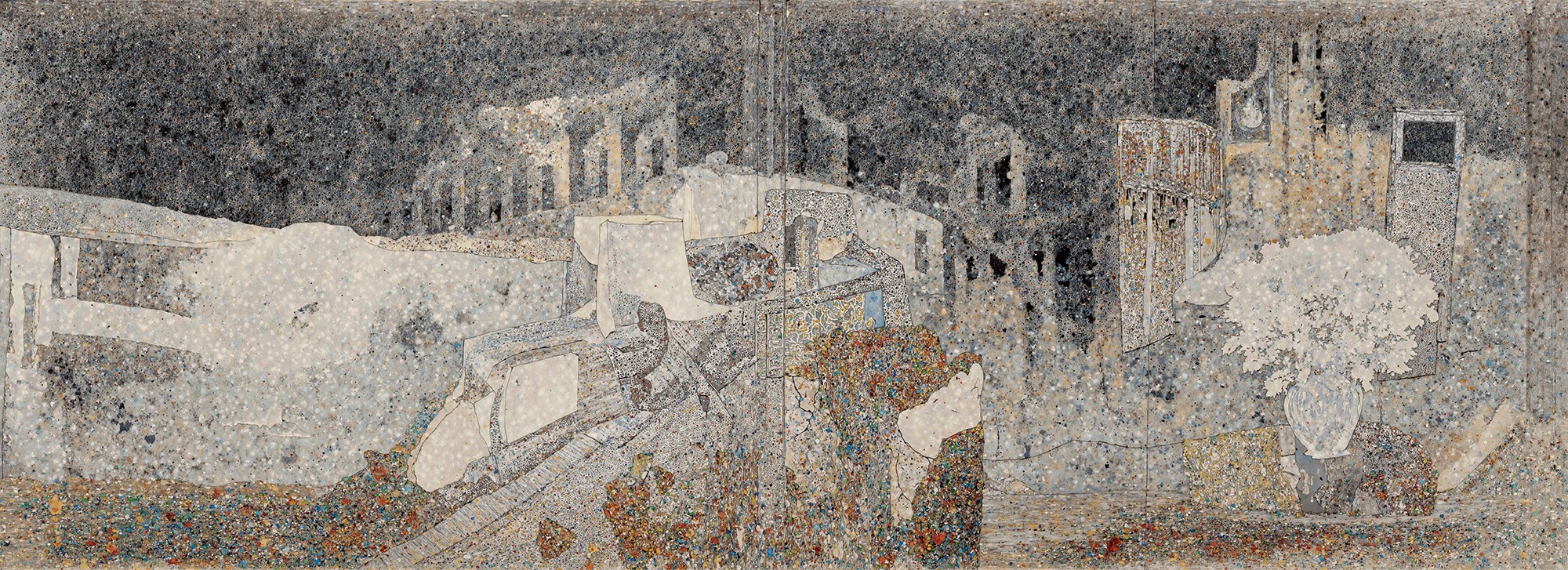
              thumbnail: the walled-city landscape rendered as a tightly
              stippled, multi-color mosaic.

Variation 1

Holly

A variation worked out in a miniature space — color breakdown and reimagining of surface quality.

Zach

This first variation is the simplest test of the idea: take Holly's collage, start with the original and reimagine the surface without losing and of the structural form. The composition is held. The palette has been broken down into a different vocabulary of color than the original used, and the surface reads as a different material than magazine cuts.

Variation 1
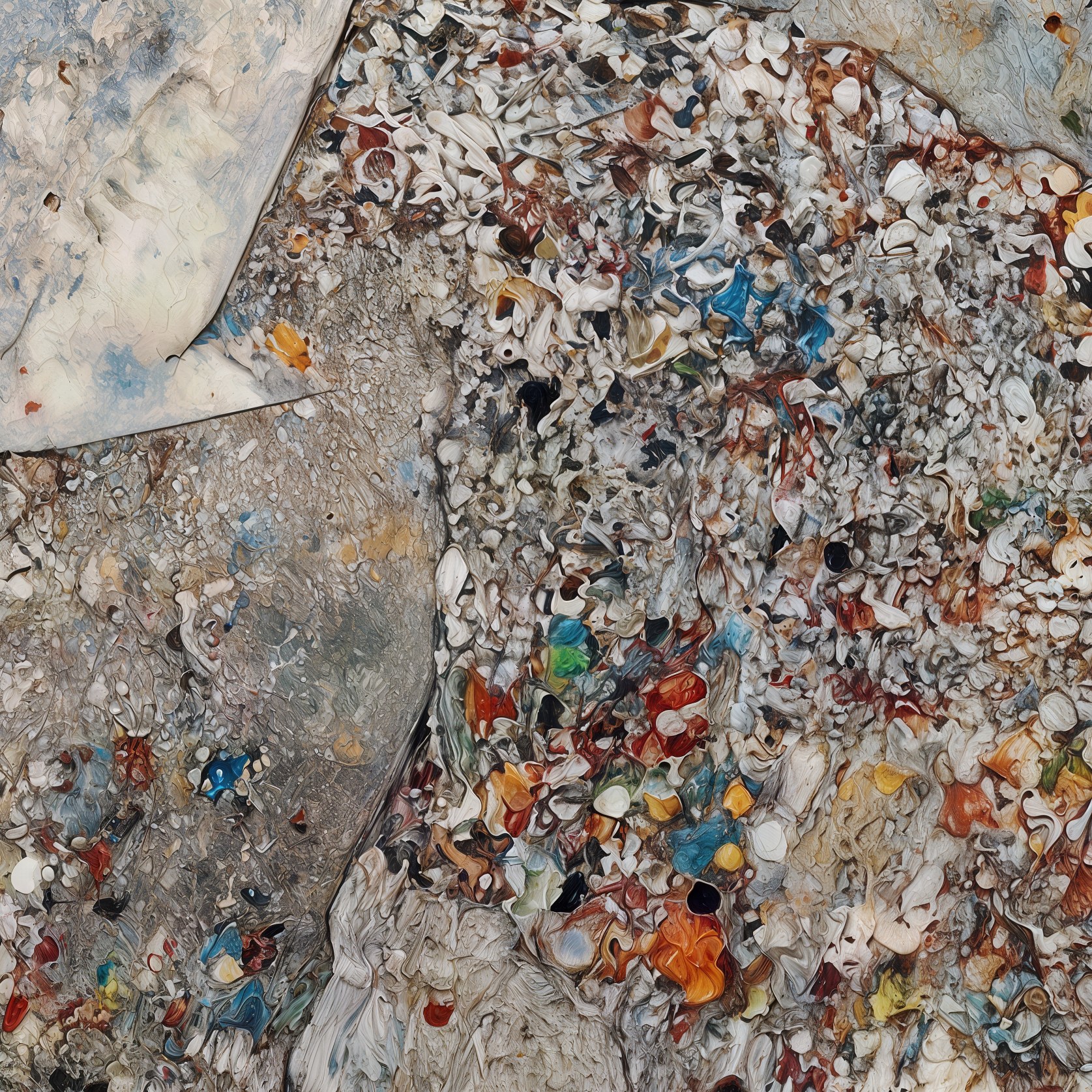
              detail at full resolution: a close crop showing the mosaic
              surface in vivid detail — discrete tiles of color in red,
              blue, white, and grey.

Detail at full resolution

Holly

Enlarged detail of breakdown of color spaces as a mosaic.

Zach

Every one of these images is built to a very high resolution — large enough to print at sizes well past what the original notebook page could ever be. That is intentional. Working bigger is awe-inspiring in a way that working at sketchbook scale is not, and it also changes what the work can do: a piece that is the size of a wall has to reward viewers at three different distances. From across a room, at conversation distance, and at inches away. The mosaic reading of this detail is what shows up at the closest distance — the same image breaks into discrete color tiles you would never see in the thumbnail.

Variation 2
              thumbnail: an interior view looking out through windows at
              a stormy twilight landscape with the walled city visible.

Variation 2

Holly

Thumbnail sketch — closer to the original collage. Here we have brought the viewer inside, viewing out onto the fantasy. The viewer is now looking out on a landscape of a stormy summer day, fading light at twilight.

Variation 2
              detail at full resolution: a soft watercolor-like
              rendering of the walled city's left edge, in muted ochres
              and dusty greens.

Detail at full resolution

Holly

Enlarged portion of the left-hand side of the walled city. Here the coloration is very soft, appearing more like a somber watercolor.

Zach

The softness here is a function of the description, "watercolor — pigment carried by water, bleeding into adjacent regions, edges that are not really edges." When that entry is weighted heavily, the same composition that produced the thumbnail comes back looking like a watercolor study — the architecture of the walled city is still there, but the surface has been re-narrated in a wetter, slower medium.

Variation 3
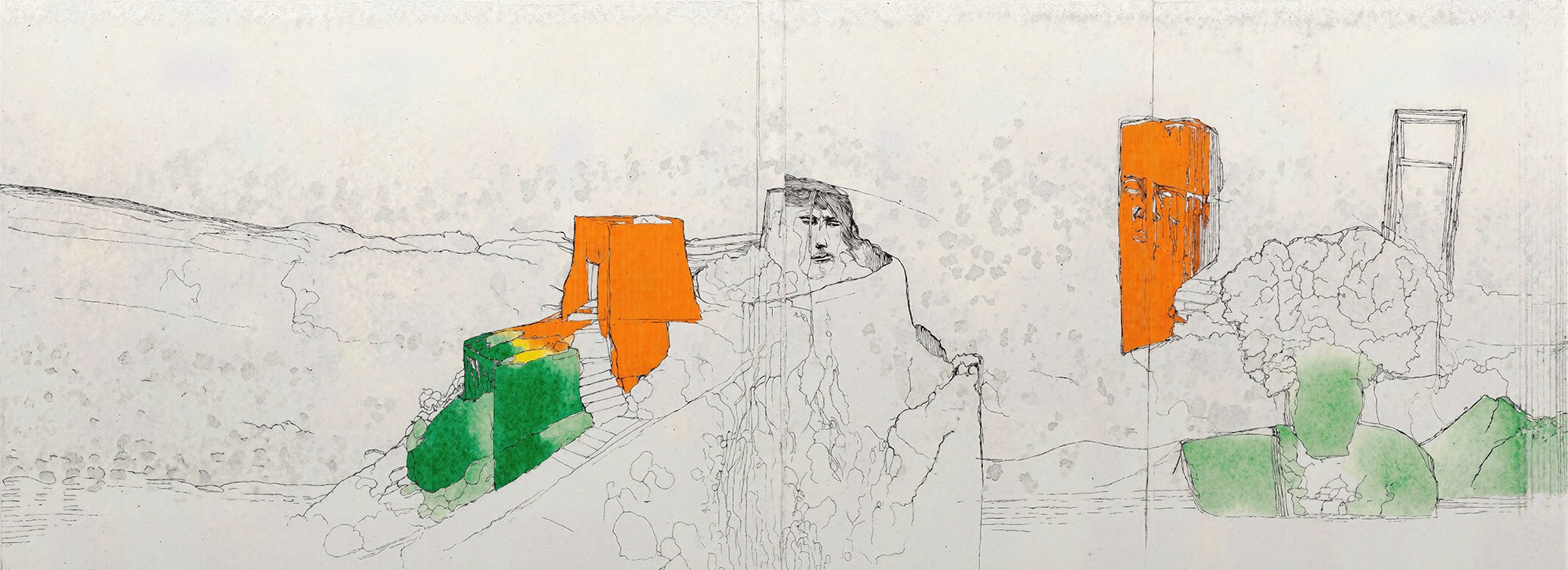
              thumbnail: fractured color-block spaces resembling a
              pen-and-ink drawing of the landscape.

Variation 3

Holly

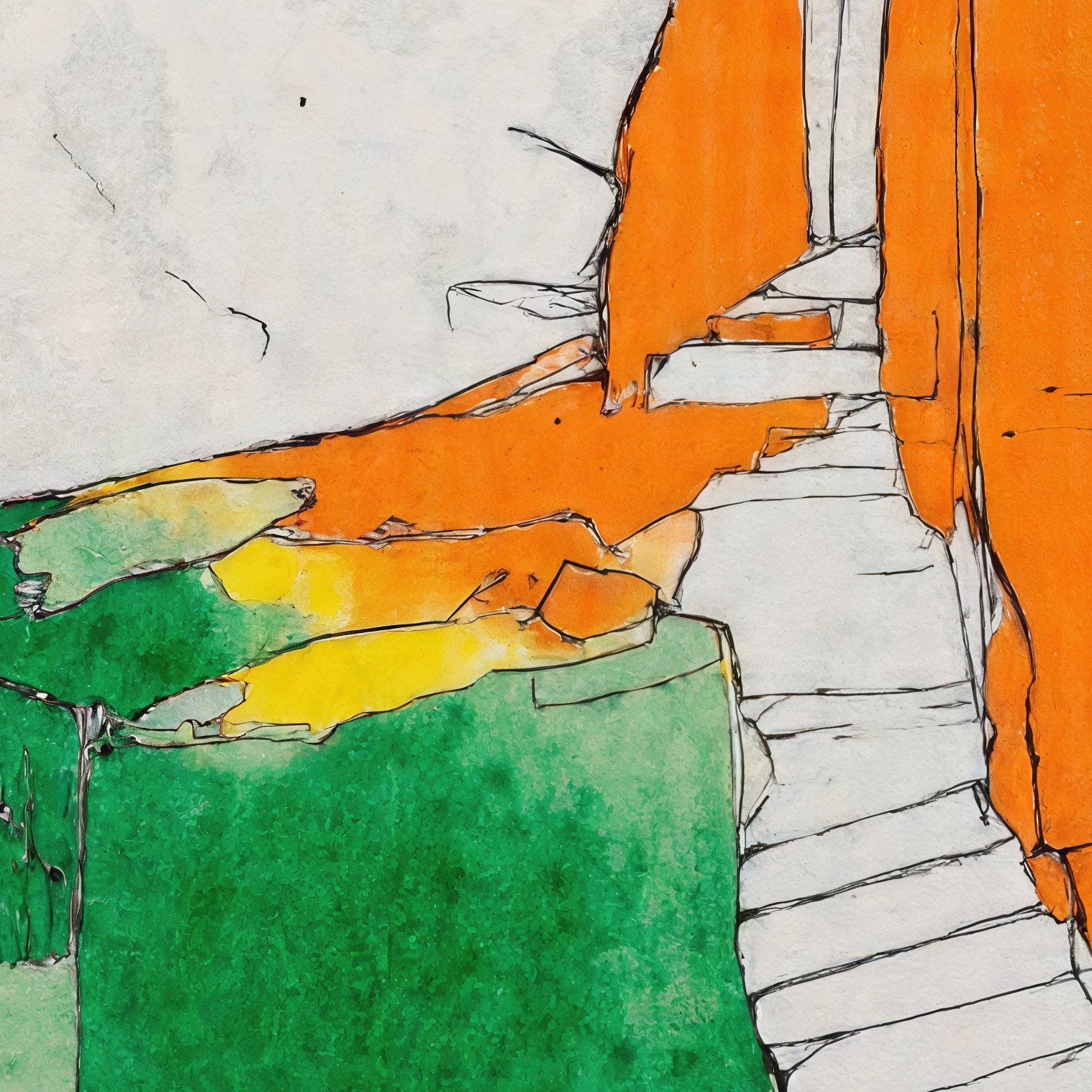
This next thumbnail is fractured color-block spaces that resemble an ink drawing.

Zach

Variation 3 is the same source material asked to behave like a different medium again. Where variation 2 went toward watercolor, this one goes toward pen and ink — flat color zones with a hard line on top of them.

Variation 3
              detail at full resolution: a section that reads as a
              beautiful ink-and-watercolor abstract, with flowing
              pigmented areas and hard linework.

Detail at full resolution

Holly

In this enlarged full resolution of a portion of the collage, one sees a beautiful ink drawing with watercolored fluid areas. This detailed resolution is only a piece of the full image, but it stands alone as a beautiful abstract.

Zach

One of the things I have always loved is paintings that demand to be looked at from different distances — at close range, a section of a larger composition stops being a section and starts being a complete image. Every variation is large enough that interesting independent compositions live inside it.

Variation 4
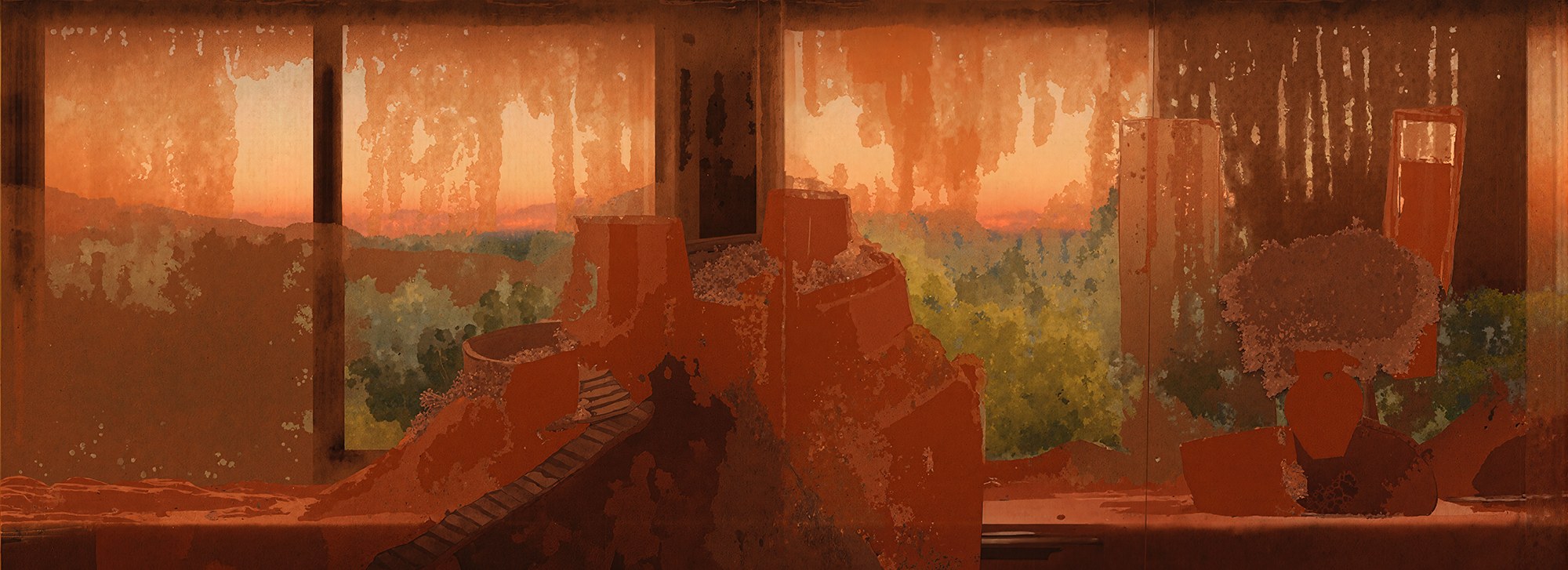
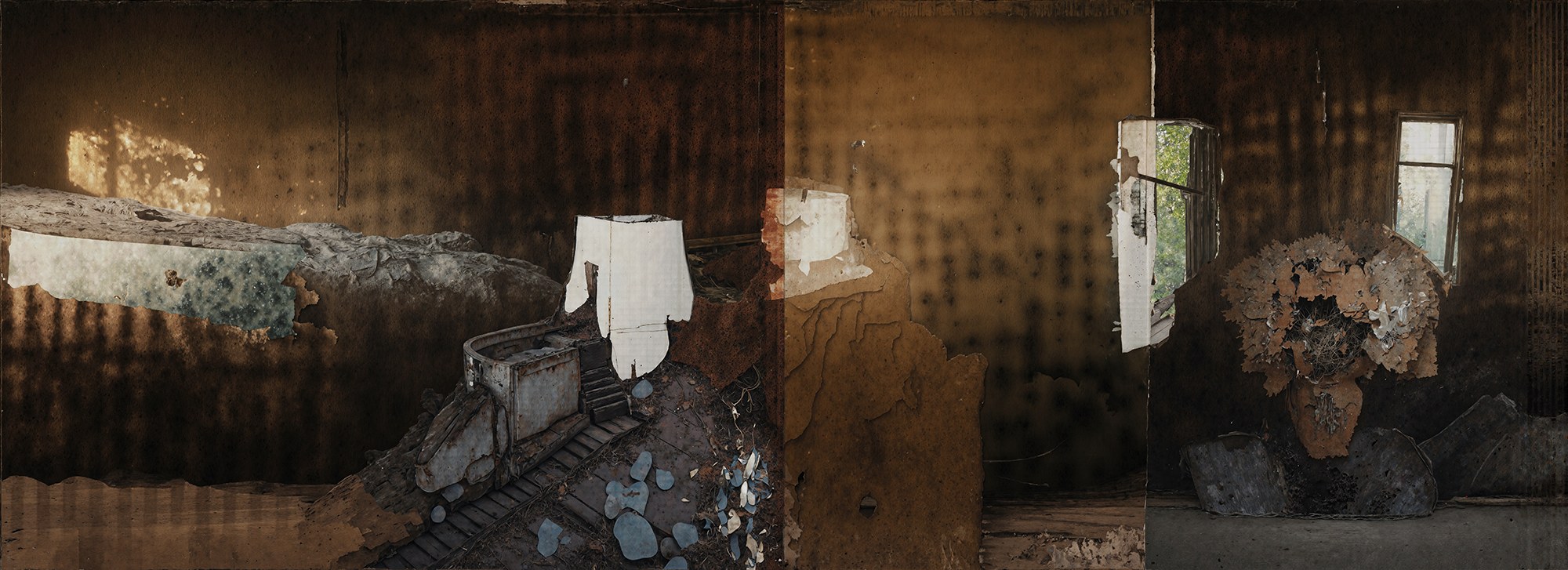
              thumbnail: a divided dark interior. Morning light streams
              through windows on the right; on the left, a bed is
              visible behind a sculpture of an ancient walled city in
              the foreground.

Variation 4

Holly

A divided dark interior. The two windows on the right-hand side view out on morning light. On the left side there is a bed in the background and a shadowed reflection on the wall behind the bed. A large sculpture of an ancient city is in the foreground.

Zach

This is the most narrative of the four variations and the one that feels most like a still from a film. The new world is still present — it is the morning light through the windows — but it has been re-imagined as a room. The ancient city in the foreground is doing two jobs at once: it is both sculptural and cutout patterns.

Variation 4
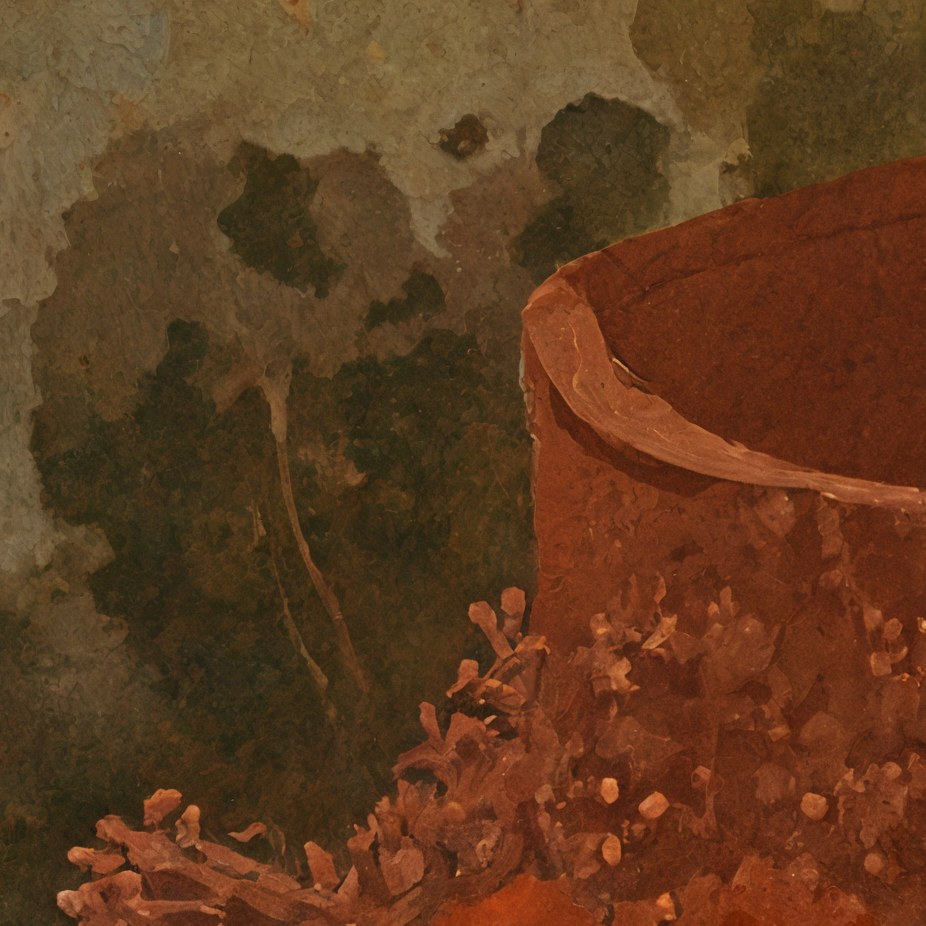
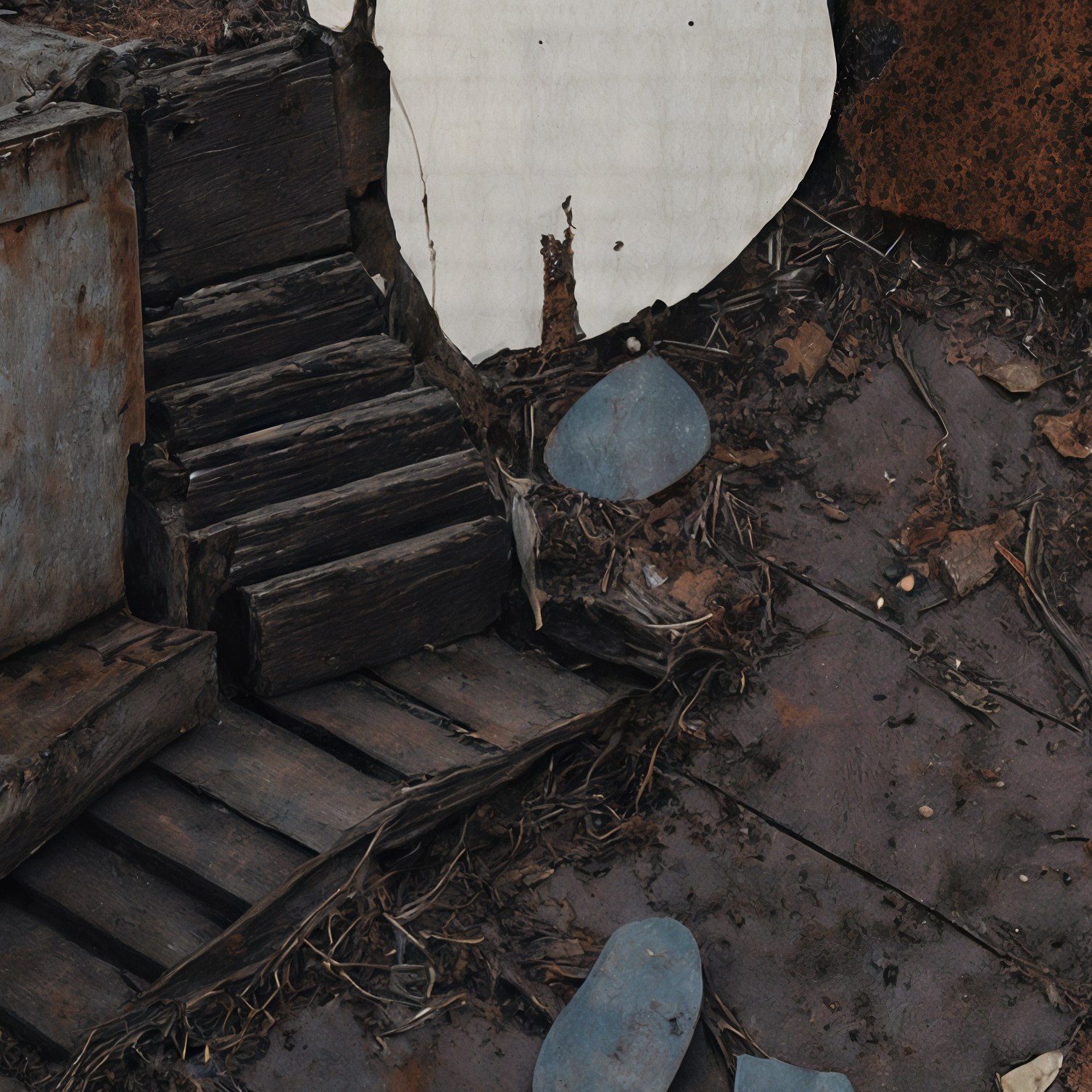
              detail at full resolution: the same interior at full
              resolution, now reading as a ruined palace — collapsed
              wooden staircase, debris-strewn floor, what was once
              architecture now wreckage.

Detail at full resolution

Holly

This variation shows a total destruction left behind what was originally a palace.

Zach

At full resolution the same scene becomes a ruin. We started with what palaces look like in Holly's other work; also what destruction looks like. Letting both descriptions run together is how a single original collage ends up containing its own collapse. We keep this variation in the set because it is the strongest argument we have for what this process is actually doing — it is not stylizing a single image, it is letting Holly's whole body of work re-narrate any one piece of it.

Where we are, and where this goes next

Isaac is mid-project. The first full-scale assembled head exists. The next iteration will have better seam alignment printed with the custom add-on Zach wrote for Blender, and a metal-leaf finish.

Only Rainbows is further along on the image side and we've only begun tests on the painting side. The four variations on the previous pages are candidates for the first physical painting, which are going to be produced on a robotic painting machine — a gantry-mounted brush running G-code, laying gel medium with the same gesture as a hand and accepting inkjet color on top of the wet paint. The intent for that machine is to keep the mistakes in. It should look like a person made it with the help of a machine.

What we have not figured out, we have not pretended to figure out. What we have, we have put in this document so that whoever sees it can understand the project from the inside — two artists, two libraries, one collage at a time.

— Holly Dale Shapiro and Zach Shukan, May 2026